2022 - 2024 · Solo
AI Glaucoma Detector
Medical AI assistant to help prevent misdiagnosis around glaucoma
- LobeAI
- Anonymous Fundus Photos
- Python
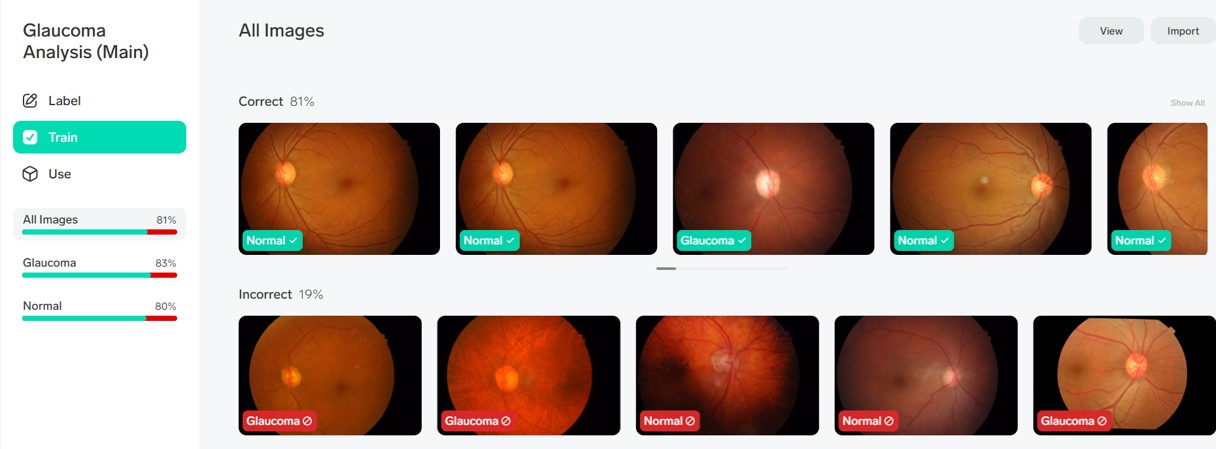
Glaucoma is often called the "silent thief of sight" as it progresses asymptomatically until irreversible peripheral vision loss has already occurred, and even trained ophthalmologists frequently struggle to catch it early, since the subtle structural changes to the optic nerve head and retinal nerve fiber layer that precede functional damage are notoriously easy to misread, leading to high rates of both false positives and false negatives in clinical screening. Motivated by this diagnostic gap, I designed and trained a deep learning system to assist in earlier, more consistent glaucoma detection from retinal fundus imagery. The model is built on a ResNet-50v2 convolutional neural network architecture, developed and trained using LobeAI, and relies on supervised learning over labeled fundus image datasets to learn the discriminative structural features — cup-to-disc ratio abnormalities, neuroretinal rim thinning, and other optic nerve head characteristics — that separate glaucomatous from healthy eyes. Through iterative training and architecture tuning, the model reached 81.3% overall accuracy, 83% sensitivity, and 80% specificity, a balance that reflects a deliberate effort to catch true positives without flooding clinicians with false alarms. What began as a technical exploration into medical image classification turned into a two-year research effort: I partnered with a glaucoma specialist in India with hundreds of publications to her name, who provided clinical grounding and helped validate the model's outputs against real diagnostic criteria, and together we prepared the findings for submission to the Indian Journal of Ophthalmology. The path to publication involved multiple rounds of revision with the journal's peer reviewers, refining the methodology, tightening the statistical reporting, and strengthening the clinical framing until the paper met the bar for acceptance. The resulting 2024 publication (PMC11001223) has since been cited 20 times and earned an appreciation certificate from the journal for its content and impact — a validation of both the technical approach and the two years of persistence behind it.